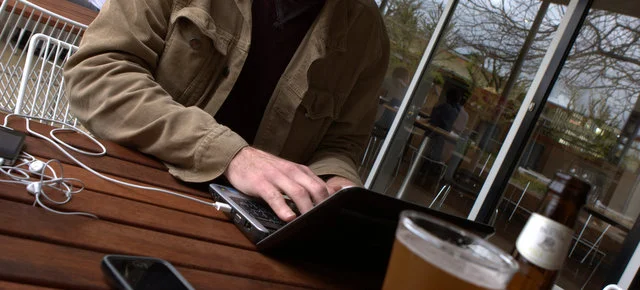
Maybe it’s just me, but when I read about Trove in The Punch, several hours disappeared before I realised it. Of course I started searching for “beer” and was amazed at the results that came back…
A year after Fosters launched in Australia, they were advertising about it being “highly nutritive” in The Argus, which may have been why they were so certain that it was going to become the national drink of Australia.
Fosters also reported an increased beer sales in 1895, as well as receiving from Prince Regent Luitpold the first consignment of that season’s Bohemian hops – which were reportedly of choice quality.
Keeping with the CUB theme is this photo that is identified as being:
 Holding the bottle of Melbourne Bitter beer, part of a gift parcel from the RSL is, Sergeant (Sgt) Brian Charles Cooper MM, 2nd Battalion, The Royal Australian Regiment (2RAR), of Perth, WA (right), who won an immediate award of the Military Medal (MM) for his conduct in action fought on the night of 24 July 1953. Sgt Cooper, commander of a Vickers medium machine gun section, came under fierce attack by an enemy force of estimated Company strength following a heavy artillery barrage. Leaving sufficient of his gun crews to man the guns covering his primary task of guarding the western approaches to The Hook, he organised the remainder into a separate defensive position. From this position he engaged the enemy with such a volume of grenades and small arms fire that they were unable to penetrate the position despite the overwhelming superiority of numbers. He called down friendly fire so close to his own and neighbouring US positions that he prevented the enemy from pressing home any further organised attacks. Sgt Cooper also continued to pass back information to the Battalion and personally supervised the evacuation of wounded to safety through an area in which the enemy moved and under heavy shellfire. He displayed throughout cool courageous leadership. With Sgt Cooper is Corporal Ron Walker of Bayswater, one of the brave band who fought in the battle. Note the tin of Johnson's baby powder, part of the gift pack.
Castlemaine Perkins and Fourex features prominantly too, including these ads from the early 1900s…


I don’t speak German, but the google translation of the first is:
Fourex, The memory of the last bottle of beer in the verkäuff the next bottle of XXXX
You get the point.
Then there’s this article on lager beer from Burton-on-Trent, interesting because I had never realised that Burton produced lagers – and that the beers tastes of garlic…
WALKER'S LAGER BEER.
Walker's Lager Beer, concerning which an advertisement appears in another column, is brewed in England, at Burton on-Trent (so noted over five centuries for the purity and suitability of its water) by a firm established for upwards of 50 years. It is brewed from only the best malt and hops, and produced under the most perfect hygienic conditions that both scientists and modern mechanical skill can devise. It has no sediment, is conditioned for many months by nature's own process-is free from the objectionable preservatives used in foreign lagers, and reaches the consumer in bright, palatable condition. It contains a very small amount of alcohol and a relatively large amount of nutritive material. In addition, it is appetising and digestive. It is therefore not only light and refreshing, but it is claimed to be an ideal dietetic. It may be obtained through all wine, spirit, and beer merchants. The "Lancet" writes; -"Lager implies a stored or matured beer, the word itself meaning a storehouse. Storage implies time, and time means expense. The essential difference between English beer and lager beer is that the former is brewed at a comparatively high, temperature, and the latter at a low temperature. The work of the yeast in lager beer proceeds at the bottom of the vat, the so-called bottom or sedimentary fermentation, while in the brewing of English beer the fermentation at the higher temperature proceeds at the surface and much more rapidly. Surface fermentation succeeds therefore in preparing briskly foaming and strong beers, bottom fermentation produces the cold, light lager. The products are different in flavour, in nutrient value, in alcoholic strength. Some people imagine that lager beer is flavored with garlic. That is not the case. The peculiar taste has its origin entirely in the mode of fermentation adopted. A matter of genuine dietetic importance is that while lager beer contains a higher proportion of nutritive substances than ordinary brewed Burton ale the amount of alcohol in it is decidedly less while the process is conducted throughout not only in the cold but under seal. Lastly the beer is preserved by a carefully conducted method of pasteurisation the object of which is to keep the product in a sound condition, the control over this process being such that no disturbance of the delicate flavor is incurred. The foregoing facts apply to the Burton lager which Messrs Peetr Walker &, Son have placed upon the market"
The site truly is a trove and a great place to while away a few hours ‘researching’ over the quieter summer days at work.